About the Journal

|
Journal Information |
Description |
|
Journal Title |
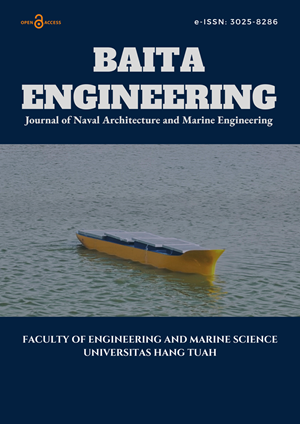
BAITA Engineering: Journal of Naval Architecture and Marine Engineering |
|
Initials |
BAITA Engineering |
|
Publication |
2 Issues per Year (June and December) |
|
DOI |
10.30649/baitaengineering |
|
Online ISSN |
3025-8286 |
|
Editor in Chief |
Prof. Bagiyo Suwasono |
|
Publisher |
Universitas Hang Tuah Surabaya, Indonesia |
Aims and Scope
BAITA Engineering: Journal of Naval Architecture and Marine Engineering is a peer-reviewed, open-access journal dedicated to the dissemination of high-quality, original research articles that advance the boundaries of maritime technology and engineering. Published by Universitas Hang Tuah Surabaya, the journal serves as an international forum for academics, researchers, and practitioners to exchange innovative ideas, methodologies, and technological advancements. The journal publishes articles with a focus and scope not only on Naval and Marine Engineering
The journal also invites scholarly contributions across a comprehensive spectrum of marine and naval engineering disciplines, including but not limited to:
· Naval Architecture & Advanced Design:
Ship Design & Production, Ship Hydrodynamics, Computer-Aided Ship Design (CASD), Seakeeping and Maneuverability, Intact and Damage Stability, and Digital Twin Technology in ship design.
· Marine Engineering & Propulsion Systems:
Ship Propulsion Systems, Machinery Integration, Marine Power Plants, Vibration and Underwater Acoustics, and Advanced Energy Management Systems.
· Green & Sustainable Maritime Technology:
Alternative Marine Fuels (e.g., LNG, Hydrogen, Ammonia), Decarbonization Strategies, Ship Energy Efficiency (EEDI/EEXI, CII), Emission Reduction Technologies, and Renewable Marine Energy (Offshore Wind, Wave, and Tidal Energy).
· Structural Integrity, Materials & Manufacturing:
Ship Construction & Strength, Ship Material & Welding Technology, Structural Health Monitoring, Fatigue and Fracture Mechanics, Corrosion Protection, and Advanced Composites in Marine Applications.
· Smart Shipping & Autonomous Systems:
Unmanned Surface Vessels (USVs), Autonomous Navigation, Maritime Internet of Things (IoT), Artificial Intelligence in Marine Systems, and Dynamic Positioning (DP) Systems.
· Advanced Computational & Ocean Engineering:
Computational Fluid Dynamics (CFD), Fluid-Structure Interaction (FSI), Ocean Engineering, Design of Offshore Structures (e.g., Platforms, FPSOs), Subsea Engineering, and Mooring System Dynamics.
· Operations, Safety & Lifecycle Management:
Ship Maintenance & Repair, Sea Transportation and Maritime Logistics, Maritime Safety and Risk Assessment, Reliability Engineering, and Human Factors in Marine Operations.