
Peer-review Journal
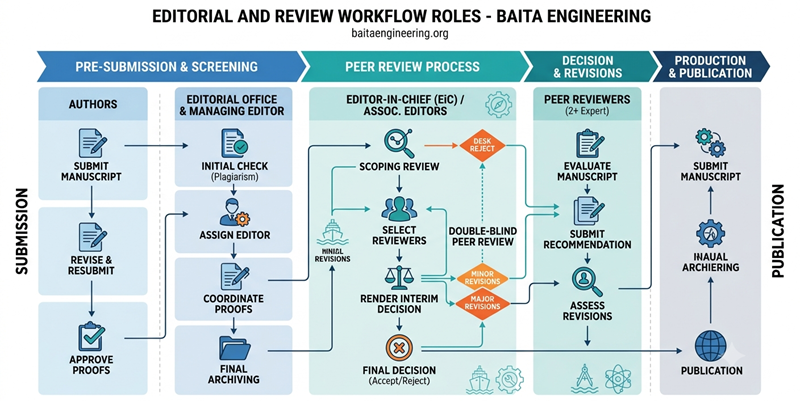
Phase 1: Conceptualization & Scope Definition
1. Identify Scope & Unique Value Proposition
- Focus Area: Define precise domain boundaries (e.g., Marine & Naval Engineering, Renewable Offshore Tech, AI in Civil Infrastructure).
- Niche & Need: Ensure the journal addresses an existing gap in current academic literature.
- Target Audience: Identify prospective authors, reviewers, and institutions.
2. Formulate Editorial & Publication Policies
- Peer-Review Model: Select your model (e.g., Double-Blind, Single-Blind, or Open Peer Review).
- Publishing Model:
- Diamond Open Access (Free for authors & readers—often grant/university-funded)
- Gold Open Access (Author/Institution pays an Article Processing Charge - APC)
- Subscription/Hybrid
- Ethics & Guidelines: Draft COPE-compliant policies covering plagiarism limits, AI usage, author contributions, and conflict of interest disclosures.
Phase 2: Editorial Board & Governance
1. Recruiter Team & Board Members
- Editor-in-Chief (EiC): Establish a recognized researcher with a strong publication record and network.
- Associate Editors & Editorial Board: Recruit a diverse international panel covering all sub-disciplines within your scope.
2. Define Roles
Editor-in-Chief ──► Associate Editors ──► Managing/Technical Editors ──► Reviewer Pool
Phase 3: Technical Infrastructure & Branding
1. Journal Management System (JMS)
Set up a management platform to handle submissions, peer review, and publication:
- Open Journal Systems (OJS): Free, open-source, and widely used by academic publishers.
- Commercial Alternatives: ScholarOne, Editorial Manager, or Janeway.
2. Branding & Domain Setup
- Secure a dedicated domain (e.g., baitaengineering.org).
- Design a clean, responsive website with clear navigation for:
- About the Journal
- Editorial Board
- Author Guidelines
- Current & Archive Issues
- Ethics & Malpractice Statement
Phase 4: Legal Registration & Identifiers
1. ISSN (International Standard Serial Number)
Apply via your national ISSN centre or ISSN International Centre after publishing your first issue or setting up the initial platform:
- e-ISSN: For online publication.
- p-ISSN: For print publication (if applicable).
2. DOI Registration
Partner with a registration agency to assign unique DOIs to every published paper:
- Crossref: Standard for academic articles.
- DataCite: Ideal for data-heavy repositories.
Phase 5: Call for Papers & Launching the First Issue
1. Call for Papers (CFP)
- Invite founding articles via direct outreach to reputable researchers, conferences, and academic networks.
- Consider publishing an initial Inaugural Issue or Special Issue with 5–8 high-quality papers to set the academic bar.
2. Review & Publishing Process
- Desk Review: Initial screening for scope, formatting, and plagiarism (e.g., Turnitin).
- Peer Review: Assign to at least 2 independent external reviewers.
- Copyediting & Typesetting: Layout XML/PDF proofs using standard templates.
- Publication: Assign DOIs and publish online under a Creative Commons license (e.g., CC BY 4.0).
Phase 6: Indexing & Sustainability
To gain visibility and impact, apply to academic databases after establishing a consistent publishing record (usually 1–2 years / minimum 10–20 papers published on time):
|
Target Database |
Requirement Highlights |
|
Google Scholar |
Automatic indexing via properly structured metadata on your web platform. |
|
DOAJ (Directory of Open Access Journals) |
Strict Open Access guidelines, transparent fees, licensing, and ethical policies. |
|
Scopus / Web of Science (ESCI) |
Requires consistent publication history, peer-review transparency, international board, and citations. |